|
||
| The detector
measures the concentration of sample bands as they leave
the column and pass through the detector flow cell. When
no band is passing through the detector, a constant
signal is recorded -- called the Baseline of the chromatogram or detector.
When a sample band reaches the detector, the detector
responds to the difference in the mobile phase properties
caused by the presence of the sample compound, giving
rise to a change in detector signal, seen as a Peak.
|
||
| How
does the detector work? In most cases we will be using a
photometric detector, commonly called a UV detector. In
its simplest form, this consists of a light source, a
flow cell (or "sample cell"), and a light
sensor as shown at the right.
|
Simplified schematic diagram of a UV detector.
|
|
| When no sample
is flowing through the detector, light passes through the
flow cell and generates a maximum signal at the light
sensor. If a sample band enters the detector, the sample
reduces the amount of light reaching the sensor and
causes a change in the detector signal. This signal is
electronically inverted by the data system resulting in
the appearance of a positive peak in the chromatogram.
The signal displayed increases in proportion to the
concentration of sample in the flow cell. The detector
will also respond to other changes in the contents of the
flow cell. For example, if particulates or "dirt"
are trapped within the flow cell, these will interrupt
the the light passing through the flow cell and cause a
change in the baseline. Or an air bubble can be trapped
in the flow cell, causing a large change in the amount of
light passing through. In this case, the signal might go
completely off-scale, then return to the original
baseline if the bubble passes through the cell.
|
||
Two types of UV detectors
are commonly used today:
Variable-wavelength detectors are less expensive; they are the standard detector type for quantitative analysis and routine assays. Photodiode array detectors are more versatile, because they allow simultaneous acquisition of both chromatographic and spectral information; they are frequently used in method development. The detector wavelength is an important characteristic of an HPLC separation. As a general rule, the wavelength is set to the absorbance maximum of the analyte. Using the wrong wavelength may result in decreased peak sizes, or even no peaks at all! Because different compounds can have different absorbance spectra, a direct quantitative comparison of different peaks in the same chromatogram can be misleading. A small quantity of a compound which absorbs strongly at the detector wavelength can give a bigger peak than a large quantity of a weak absorber. For reliable quantitation, a calibration must be carried out with a known quantity of the exact compound to be analyzed.
|
The Variable Wavelength UV Detector uses a monochromator (slits and a grating) to select one wavelength of light to pass through the sample cell.
The Photodiode Array Detector passes all wavelengths of light through the sample cell, then focuses each wavelength on a single sensor element. |
|
| There are a
number of other settings or controls for the detector;
these may be built in to the detector itself, or may be
part of the data system:
|
||
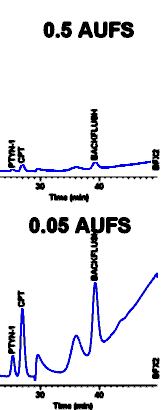
| The size of all the peaks
in the chromatogram can be changed using the attenuator
or range settings. The attenuation scale usually
indicates the size of a peak which will appear as a full-scale
peak on the display. This scale is measured in absorbance
units (which are proportional to sample concentration);
it is often expressed as "Absorbance Units Full
Scale" (AUFS). The figure at the right
illustrates the effect of a change in attenuation. As the
attenuation setting is increased (AUFS is decreased), the
detector becomes more sensitive, and all peaks increase
in size. On many systems, the range or attenuation can be set either on the detector itself or on the data system. If the attenuation or range is set on the data system, it usually affects only the display. It does not change the way quantitation is carried out because it does not change the information presented to the data system. If the attenuation or range is set at the detector itself however, it is possible that the size of large peaks may exceed the capabilities of the data system.
|
|
|
|
||
| Another detector setting
is the Baseline Zero (sometimes called the "Zero
Offset"). Moving this setting (shown at the right)
simply shifts the entire chromatogram up or down on the
display. As with the attenuation setting, if the zero is
adjusted at the data system, it affects the display only;
quantitation remains unchanged. If the baseline zero is
changed on the detector itself, integration may be compromised if the baseline
is offset sufficiently low to send a negative voltage
signal to the data system (most data systems can only
deal with positive voltage signals).
|
|
|