| In the original use of
chromatography, a band could be identified by the
distance traveled in a constant time. In the example at
the right, the red pigment travels further than the blue
pigment which travels further than the green pigment. If
the separation is repeated under identical conditions (not
always easy to do!), each of the pigments will always
travel its characteristic distance, determined by the
balance between solubility in the mobile phase and
affinity for the stationary phase.
|
|
|
| As we have
seen, a chromatogram is a plot of detector response as a
function of time. In a properly functioning HPLC system,
the detector response is directly proportional to the
concentration of analyte in the column effluent. At
constant flow rate, the volume of column effluent that
has passed through the detector is directly proportional
to the elapsed time. In
HPLC, all analytes travel the same distance (the length
of the column), so we characterize compounds by retention
time. Faster-moving analytes have a shorter retention
time than slower-moving analytes. Retention time, like
migration distance in the original chromatography
experiment, is determined by the balance between
solubility in the mobile phase and affinity for the
stationary phase. If the separation were repeated under
identical conditions (much easier to do in HPLC!), then
each analyte would always elute from the column at its
characteristic retention time. That retention time can be
used to identify compounds (qualitative analysis). |
||
|
||
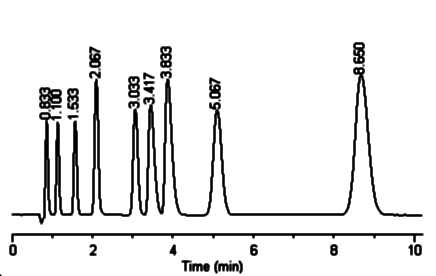
| By convention, the
retention time (tR) is measured from sample
injection (the start of the chromatogram) to the apex (high
point) of the peak. Retention times are usually
determined automatically by the data system. They are
often included on the chromatogram printout as well as
being available in a report about the separation.
|
Chromatogram with 9 peaks showing retention times.
|
|
| If standards (sometimes
also called "calibrators") containing known
compounds are run, then the data system can "remember"
the retention times and automatically associate analyte
names with the peaks. The example at the right shows a
data system report that has both peak names and retention
times.
|
Data system report showing peak retention times, area, height, and names. The names are established by running standards.
|
|