| |
|
| In classical
open-column chromatography, the mobile phase flows
through the bed of column packing because of gravity.
This works (barely) with large-particle-size packings (particle
diameters larger than 50-100 microns or so), but
separation times can be extremely long. In order to
reduce separation time and allow the use of smaller
particle size packings (10 microns and below), we must
force the liquid mobile phase through the column under
pressure. This is the function of the pump (also called
the "solvent delivery system"): to maintain a
constant flow of mobile phase through the HPLC regardless
of the pressure (back pressure) caused by the flow
resistance of the packed column.
|
| Most
commercial HPLC pumps are based on a reciprocating piston
design, as shown here. A motor-driven cam pulls the
piston back and forth in the pump head. A flexible seal
around the periphery of the piston prevents leakage of
mobile phase out the back of the pump. Check valves
mounted in the head open and close in response to small
changes in pressure to maintain a one-way flow of solvent.
The pump cylinder
with its check valves is often accessible from the
outside to allow easier servicing of the check valves and
replacement of the pump seals. This part of the pump is
called the pump head.
|

Cross-sectional diagram
of a simple single-piston reciprocating pump
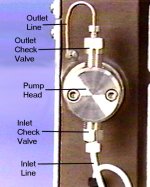
Typical pump head
assembly.
|
| |
|
| The
diagram below shows how pump flow varies with time: 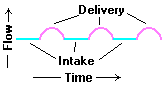
During the
delivery stroke, flow increases from zero up to a maximum,
then decreases back to zero. During the intake stroke,
flow is zero. The pressure inside the pump changes in the
same way as flow -- going from zero to a maximum value,
then staying at zero during the intake stroke.
|

Single-piston
reciprocating pump operation.
|
| |
|
The kind of flow shown
above, where flow rate changes during the pumping cycle,
causes pressure pulses. Pulses are undesirable
for several reasons:
- they cause detection
problems
- they prevent good
quantitative analysis
- they lead to early
column failure.
Most of the differences in
pumps from different manufacturers are modifications to
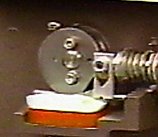
give more uniform flow. One approach is to keep the
single-piston design, but to vary the shape of the cam
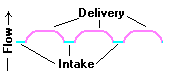
and /or the speed of the motor. This leads to a change in
the flow as shown at right. The shape of the cam leads to
a flatter flow curve at the middle of the delivery stroke.
In addition, the motor speeds up during the intake stroke
and slows down during the delivery stroke. Some pulsation
still remains, however, and these pumps often use some
form of "pulse dampening" to further reduce the
flow fluctuations.
|
|
Shaped (non-circular)
cam to minimize pressure pulses.
|
|
Output flow
from a shaped-cam pump.
|
|
| |
|
| Another common
approach combines the output flow from two heads
operating 180 degrees out of phase, such that the intake
stroke from one head coincides with the delivery stroke
from the second head. This means that while one cylinder
is filling the pump cylinder, the second cylinder is
delivering mobile phase. Then, when the second refilling,
the first cylinder delivers. We can combine these two
flows by feeding each pump output into a tee that
connects with the HPLC system. Now the combined flow of
both heads delivers a much smoother, less pulsing flow to
the LC system. The inlet line from the reservoir likewise
is fed to a tee that branches to feed both cylinders of
the pump. Pump pulsations can be reduced further by
special cam shapes, by varying the speed of the pump
motor, and by the use of pulse dampers.
|
|
| Another approach to
reducing pump pulsations while keeping the pump design
fairly simple is the Tandem Piston Pump. A large and a
small piston / cylinder unit are combined to provide
continuous flow of mobile phase from the pump. While the
large piston fills, the small piston delivers. When the
small piston fills, the large piston delivers enough
mobile phase to both fill the small piston and provide a
net flow of mobile phase to the LC system. Notice that
only three check valves are required for this pump versus
four check valves for a conventional two-piston pump.
|
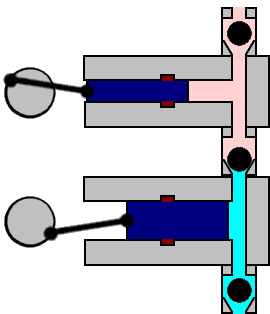
A tandem-piston pump
provides a continous output flow.
|
| |
|
| Most LC pumps
(even those with multiple heads) have some pulsation in
the flow from the pump outlet. This is often smoothed out
by the use of a Pulse Damper. These devices typically
consist of a coil of flexible stainless-steel tubing.
When the pressure rises (as a result of flow pulsation),
the tubing stretches and its volume increases so that the
extra flow from the pump at this moment is accommodated
by the extra volume of the pulse damper. When the
pressure decreases, the tubing volume decreases, with the
extra solvent going to make up for the flow deficit. In
effect, the pulse damper acts as a hydraulic "shock
absorber" to smooth out pulsating flow.
|
|
| |
|
