The pump can
be used to mix or blend the mobile phase as well as to
deliver it to the system. Usually, the mobile phase is a
mixture of two or more solvents. We refer to 2-solvent
mobile phases as "Binary", 3-solvent mobile
phases as "Ternary", and 4-solvent mobile
phases as "Quaternary" mixtures. Commercial LC
pumps are available that can automatically blend 2, 3, or
4 solvents into a final mobile phase. We can formulate or
mix a mobile phase in one of three ways:
- manual (without a pump)
- with low-pressure
mixing by the pump
- with high-pressure
mixing by the pump
Manual mixing of mobile
phases is the simplest and the most precise. If we need a
large volume of mobile phase for the analysis of a large
number of samples by the same procedure, manual mixing is
probably the best approach. On the other hand, if the
mobile phase composition is varied during unattended
operation of the LC system, then "on-line"
mixing will be required.
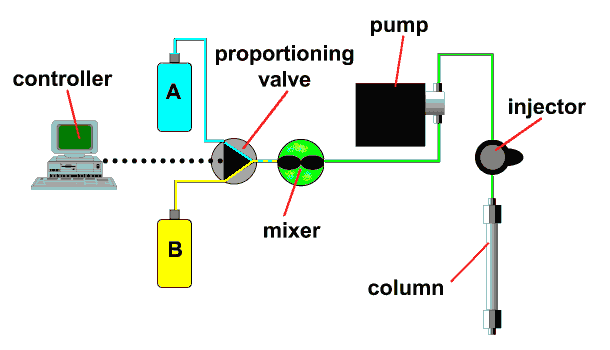
Many HPLC pumping systems allow the
mobile phase composition to be controlled by "on-line
mixing". Some systems blend the output of two
independent pumps; these are referred to as "two-pump"
or "high-pressure mixing" systems. Others use a
proportioning valve to control the input to a single pump;
these are referred to as "one-pump" or "low-pressure
mixing" systems. On-line mixing systems can be used
for either isocratic HPLC (in which the mobile phase
composition is constant during a run) or gradient HPLC (in
which mobile phase composition is changed during a run).
Although on-line mixing is not required for isocratic LC,
it makes mobile phase preparation more convenient.
|
|
|