| |
|
| Degassing (How do
I degas thee? Let me count the ways). Four approaches are
commonly used to remove excess dissolved gas from mobile
phase solvents:
|
|
| 1.
Sonication. When pure solvents are mixed to make
up the mobile phase, excess dissolved gas escapes to form
bubbles (remember, air is less soluble in solvent
mixtures than in pure solvents). If the mobile phase
reservoir is placed in an ultrasonic bath, the sound
waves promote the coalescence of small bubbles which can
escape more easily. This type of degassing works for
premixed mobile phases by allowing the excess gas to
escape before it enters the pump. It is not recommended
for on-line mixing systems, in which bubbles form inside
the HPLC system, because it cannot reduce the
dissolved gas below the saturation level of the pure
solvent. Sonication is often used in conjunction with
vacuum degassing.
|
|
| 2. Vacuum.
This is very convenient because it can be combined with
vacuum filtration of the mobile phase to remove both
dissolved gas and particulate contamination. Like
sonication, with which it is often combined, this
technique works for premixed mobile phases, but is not
recommended for on-line mixing; it is a "one-shot"
technique, because the mobile phase immediately begins to
re-equilibrate with air.
|
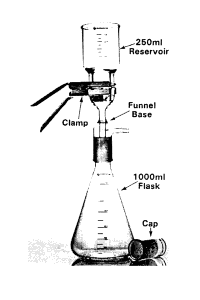
Vacuum filtration is
often combined with sonication to remove excess dissolved
gas from premixed mobile phases.
|
| |
|
| 3. Helium sparge.
A stream of helium bubbles will sweep dissolved air out
of liquids (helium is virtually insoluble in most HPLC
solvents, so very little helium replaces the air). Helium
sparging is very effective; it can reduce the dissolved
air in common solvents to levels below the saturation
level of mixtures. This makes helium sparging especially
suitable for use with on-line mixing systems. While
helium sparging entails some risk of changing the mobile
phase composition by selectively evaporating the more
volatile components, this is usually not a problem if an
excessively vigorous flow of helium is avoided (in other
words, "don't overdo it!").
|
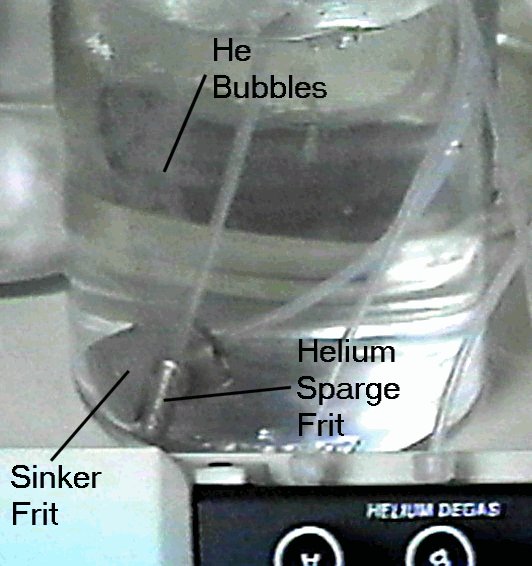
He sparge degassing
system. Note the large "sinker" frit on the
inlet line and the smaller helium sparging frit with the
plume of He bubbles rising through the mobile phase.
|
| |
|
| 4. On-line
membrane degassing. In many respects, this is
the most convenient approach to degassing. The mobile
phase or solvent flows through a hollow fiber made of a
semi-permeable membrane. A partial vacuum is maintained
on the outside of the membrane. Because air can diffuse
through the membrane while solvent vapor cannot,
dissolved air is removed from the solvent before it
reaches the pump. The membrane degassing module is
usually plumbed into the inlet line immediately upstream
of the pump, so that there is no opportunity for air to
redissolve.
|
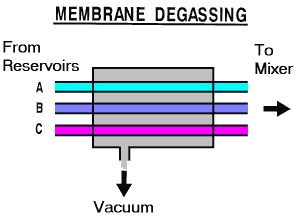
A membrane degasser uses
a semi-permeable membrane passing through a vacuum
chamber. Gasses diffuse throught the membrane and are
removed. Solvents are retained.
|
| |
|
