| |
|
| The pressure between the
pump and the HPLC column is controlled by the flow
velocity of the mobile phase through the column (the
higher the flow, the higher the pressure), by the
viscosity of the mobile phase (the higher the viscosity,
the higher the pressure), and by the flow resistance of
the column (smaller particle sizes, longer columns, and
narrower columns mean more flow resistance and higher
pressure). This "back pressure" may range from
several hundred to several thousand psi. In order to
introduce a sample onto the column for analysis, a
special valve called the injector must be used to
transfer the sample into the pressurized system.
|
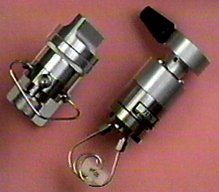
Typical HPLC injectors
made by Valco (upper left) and Rheodyne (lower right).
|
| |
|
| Injectors may
look different from the outside, but internally, most are
6-port rotary valves. These valves consist of a fixed
body (the "stator") plus an internal seal that
rotates (the "rotor"). Three internal passages
connect alternate pairs of external ports. The valves can
switch between two positions, referred to as the "inject"
and "load" positions, respectively. In the load
position, the pump is connected to the column, and the
sample inlet is connected to one end of a piece of tubing,
called the sample loop. The other end of the sample loop
is connected to the waste port. Rotation results in
reconnecting the various lines that enter the valve, so
that a sample volume can be inserted into the mobile
phase that flows from the pump to the column inlet.
|
|
| Let's see how
the 6-port sample valve works. In the LOAD position above,
the pump is connected directly to the column inlet. The
syringe containing the sample solution is inserted into
the sample inlet line and sample is forced out of syringe
into the SAMPLE LOOP; and from the loop excess sample
goes to waste. The sample loop is used to precisely
measure the volume of sample solution to be injected. If
the volume of the loop is 20 microliters (20 µL), then
by filling the loop completely the injected volume will
be exactly 20 µL.
|
|
| |
|
| Now
the seal is rotated into the INJECT position. This can be
done manually by turning the handle of the valve or it
can be done automatically using a valve actuator or
autosampler In the inject position above, the pump is now
seen to connect to the sample loop, so that flow of
mobile phase from the pump pushes the sample out of the
loop and into the column. The syringe containing the
sample solution is now connected directly to waste. While
the sample is being emptied out of the loop, the syringe
can be refilled with wash solution and used to clean out
the injection port of the sample valve. When it is time
to inject the next sample, the valve is rotated back to
the load position, a new sample is injected into the loop,
and the entire process is repeated.
|

Place your
cursor over the diagram to switch the injection valve
from the "LOAD" to the "INJECT"
position.
|
| |
|
| For the most
precise injection, the sample valve is usually used as
described above. This is called FILLED-LOOP injection. If
an excess of sample is used to fill the loop (usually 3
or more times the volume of the loop), then the injected
volume will be very precise, and this will improve the
precision of our analysis.
|
|
| If we want to vary the
sample volume we inject, another technique of sample
injection can be used: PARTIAL-LOOP injection. In partial-loop (sometimes
also called "partial-fill") injection we inject
a sample volume that is smaller than the volume of the
loop.
|
 |
| |
|
| Why would we
use partial-loop injection, when we know that it is less
precise than filled-loop injection? We may want to
deliberately vary the volume of sample injected, in order
to determine the effect of sample volume on the
separation. In this case it is easier to change the
injected volume (using the syringe) than to change the
loop on the sample valve. And we may not have all the
loops of the right volume available. Most autosamplers
allow us to carry out partial-loop injection, so that the
sample size injected can be changed automatically -
without changing the sample loop. The majority of
autosamplers can inject the sample precisely even in this
partial-fill mode.
|
|
| |
|
