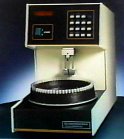
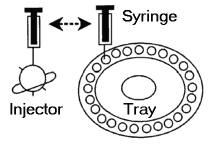
| Most modern HPLC systems
use autosamplers. The actual injection valve is the same
as the manual valves described above, but the sample is
introduced by an automated syringe drawing samples from
vials in a motorized tray.
|
|
|||
| Most
autosamplers work by penetrating the capped sample vial
with a needle attached to a length of flexible tubing.
Sample is then withdrawn from the vial into the loop of a
sample injector by suction (or positive displacement in
some cases). The injector then rotates into the inject
position at the right time for the next sample injection
into the LC. While this sample is being separated and
analyzed, the needle and injector are washed out with
rinse fluid, and the next sample vial on the turntable
rotates into position for penetration by the needle. All
of these operations (injection, rotation, etc.) are
controlled by timers in either the LC or the autosampler.
|
||||
|
||||
| Autosamplers
save work, because now you can do other things while the
autosampler is injecting samples. Some people say that
this takes all the fun out of chromatography, but people
eventually get tired of injecting samples and watching
peaks come out on the recorder. Autosamplers are more
reliable (they don't forget to inject the next sample)
and they are usually more precise. In many LC labs today you can't find an LC system without its own autosampler. However, things can go wrong with autosamplers, especially if we ignore certain recommendations. First, samples have to be very clean for injection by an autosampler. Otherwise the needle of the autosampler is likely to plug, which means that either no sample is injected or (worse) that an insufficient sample volume is injected. It is also much more important to keep track of all samples when using an autosampler, than when operating manually. One mistake could conceivably confuse the results for all the samples on the turntable. Finally, remember that the samples on the turntable may sit there for quite a while. Is there any chance that the sample might be unstable under these conditions? You might have to take samples out of the refrigerator just before placing them on the turntable, so that no more than a few samples are sitting there at any one time. Also, keep in mind that frozen samples should not be placed directly on the turntable. First thaw the samples, then mix them thoroughly - because freezing often results in "layering" of different sample components in the vial. Autosamplers differ from one brand to another. Some autosamplers are fairly simple, and they can only be operated in a limited number of ways. For example, all sample injections would have to be the same size (e.g., 100 microliters), and all runs would require that the samples be placed in sequence on the turntable. Other units are more complex and flexible, allowing for different size injections from each vial, reinjection of a calibrator from the same vial, or duplicate injections of each sample - when duplicate runs are required. Some autosamplers require a large sample, regardless of the injection volume - simply to fill the lines between the vial and the injector loop. Other autoinjectors can work with much smaller sample volumes.
|
||||