| Now let's turn
to the LC column: the most important part of the LC
system. We'll look at the different kinds of columns that
are used in HPLC, how to describe individual columns, and
how to care for the column so as to prolong its useful
life.
|
||
| By way of review, first
consider the column hardware (the metal casing of the
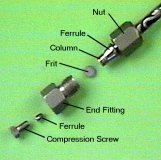
column and its connectors): We will be most concerned with the column END FITTINGS and FRITS. (Apart from the column packing inside the column, these parts of the column are most susceptible to damage from improper use). The column packing is held inside the column by the frits, and the frits are held onto the column end by the end fittings.
|
A standard HPLC column end-fitting
|
|
| Columns come
in different sizes, with the internal diameter (i.d.) of
most columns equal to 4.6 millimeters (mm) = 0.46
centimeters (cm). The length of the column is usually 10
or 15 cm long, but older columns can be longer, and
recent columns tend to be shorter. When larger samples
sizes are to be separated in order to recover purified
compounds (e.g., several milligrams to grams), preparative
columns of wider diameter are used. The inside width of
these columns can be 1 or 2 cm or wider. In order to
distinguish the usual LC column - used for analyzing
samples - from the larger preparative columns, we refer
to these everyday columns as the analytical
column.
|
||
| In order for
the LC column to do its job, it must be kept in top shape.
There are a number of ways that the column can be damaged,
and this will then be evident from the chromatogram.
Sample peaks will be broader and may no longer be
symmetrical, the retention times of different peaks may
change, and the separation will generally be poorer. Next
we'll talk about the different ways columns degrade, and
about techniques for preventing damage to the column. The most important causes of column failure are:
|
||
| Let's look at
chemical attack first. Certain mobile phases can remove
the bonded phase from the surface of the silica particle,
by breaking the chemical bond that holds this organic
layer to the silica. In addition these same mobile phases
can often dissolve the silica itself. The worst offenders
are mobile phases that are basic (pH greater than 7) or
strongly acidic (pH less than 2.5). So most
chromatographers avoid these pH extremes when developing
the conditions for an LC procedure. If you do work at
higher pH, it is possible to use column packings that are
specially designed to withstand pH extremes. The second cause of column failure is plugging of the frit or column packing by small particles of debris (particulates). These particulates are often introduced with the sample, which means that any samples containing particulate matter should be filtered, using a 0.5-micron filter that is designed for HPLC samples. If you are in doubt about sample particulates, just hold the sample solution (which you are going to inject) up to the light, and swirl it gently. You should be able to see floating particles or a cloudy appearance - if there is any problem. Column plugging can also be caused by particulates in the mobile phase or from normal wear of the HPLC system. Pump seals and the moving parts of the sample injector gradually wear, shedding particles that pass on to the column inlet. Mobile phases that are made up from HPLC solvents, with nothing else added, usually do not have a particulate problem if clean glassware is used and the reservoirs are covered to keep out dust. These solvents are carefully filtered by the manufacturer. However if solids such as buffers or ion-pair reagents are added to the mobile phase, it is good practice to filter the final mobile phases before use. Particulates from system wear - which can be a major problem - are best handled by using an in-line filter between the sample injector and the column inlet. We'll discuss this in a minute. The third cause of column damage is mechanical shock. Remember that the column is an expensive item, usually costing several hundred dollars, so treat it with the respect it deserves. Don't drop the column, and when it is not installed on the LC system put it carefully back into its original case for protection. There are other ways to shock a column, besides hitting it with a hammer. The mobile phase moving through the column exerts a force on the column packing, and if this force is great enough, it will cause the particles of column packing to squeeze together more tightly - or even to break the particles. This then leads to settling of the column packing inside the column , with the formation of a space or VOID at the inlet of the column. A void will in almost all cases cause a catastrophic loss in column performance, and require its replacement. Voids are often caused by pressure pulsations. Any rapid change in pressure at the column inlet is bad for the column. These pressure pulsations can arise in different ways. If the LC pump does not have adequate pulse-damping, there will be an irregular flow of liquid from the pump, and this will cause corresponding changes in pressure; pressure is proportional to flow rate, all other factors equal. When the sample injector is rotated from one position to the other, the flow of mobile phase from the pump to the column is temporarily blocked while the valve is rotating. This is probably the most serious cause of pressure pulsation and resulting damage to the column. Watch the pressure readout from time to time. Any rapid fluctuations by more than plus or minus 10% are a sign of a possible pressure problem - and a warning that your column may be in danger. The final cause of column damage is adsorption of impurities from "dirty" samples. Samples that are derived from plant or animal specimens, environmental samples, or chemical reaction mixtures often contain compounds that are attracted quite strongly to the bonded phase.. These gradually accumulate on the column and block the surface of the bonded phase. Sample peaks then show decrease in retention time and increase in width, and eventually the column must be discarded. This buildup of "chemical garbage" on the column can be avoided by an initial cleanup of the sample before injection. Columns that have accumulated these impurities can, in some cases, be regenerated, by washing the column with suitable solvents.
|
||
|
One way to help protect
the column is to keep good records. Record the column
identification number in your notebook whenever using a
particular column. Keep track of the samples analyzed
with each column, so that you know whether the column has
lasted as long as it should. In most cases, you should be
able to analyze 1000 or more samples before replacing a
column. However this depends on the kind of sample. This
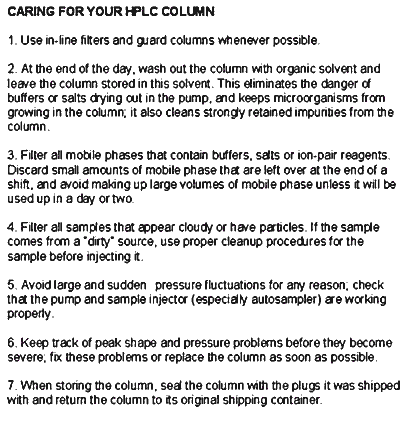
table summarizes some useful ways to take care of the
column and make it last as long as possible.
|
|