| |
|
| The main
chemical difference between the stationary phase and the
mobile phase in reversed-phase HPLC can be described in
various ways: we say that the water/organic phase is more
polar while the alkyl bonded phase is less polar. We can
describe the mobile phase as hydrophilic (water-loving)
while the bonded phase is hydrophobic (water-hating). The
bonded phase is somewhat like a wax or oil layer,
repelling water and compounds that dissolve well in water.
|
|
| Compounds that are more
polar prefer the polar mobile phase and move through the
column more quickly. Compounds that are non-polar tend to
prefer the non-polar bonded phase and move through the
column more slowly. Looking at the separation on the
right, we see that retention increases as we increase the
non-polarity of the compounds (nitrobenzene is the most
polar of the these compounds; adding alkyl substitution
decreases the overall polarity).
|
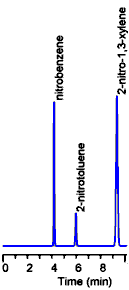
Separation of
nitroaromatic compounds on a C18 column with a 60%
methanol/water mobile phase
|
| |
|
| Generally, a decrease in
water content of 10% (e.g., going from 60% methanol/water
to 70% methanol/water) results in a 2- to 3-fold decrease
in sample retention time. Therefore, changing the water
content of the mobile phase is a good way to control the
sample separation time. Notice, however, that decreasing
the water content in order to shorten the separation time
also generally makes the separation worse; the peaks move
closer together and are not as well resolved.
|
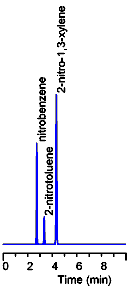
Separation of the same
sample shown above using 70% methanol/water mobile phase
|
| |
|
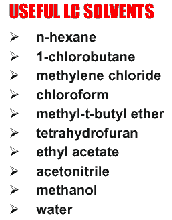
| There are about ten
solvents that are used for HPLC mobile phases. These
solvents must be specially purified before use: so-called
HPLC grade solvents. Water is an especially critical
solvent, and we use a lot of it. For this reason, many
labs purify their own HPLC-grade water using special
systems from companies such as Millipore or Barnstead.
|
|
| |
|
| In reversed-phase chromatography (the
most commonly used technique), we usually use only 3
organic solvents for the mobile phase: methanol,
acetonitrile, and tetrahydrofuran (THF). These are the
three solvents that are the most different from one
another in their chromatographic selectivity and
fully miscible with water in all proportions. Solvent
miscibility is quite important, because an LC system will
not work with a solvent combination that is immiscible.
The common reversed-phase solvents, water, methanol,
acetonitrile and THF are each miscible with each other.
You can blend them together in any proportion, and use
any combination of 2 to 4 of these solvents. Combinations
of two solvents (usually one organic solvent plus water)
are referred to as "binary" mobile phases.
Combinations of three solvents (two organic solvents plus
water) are referred to as "ternary" mobile
phases.
|
|
| A critical solvent
property is the UV cutoff wavelength. This is
particularly important when using a UV detector - which
is generally the case in LC. This UV cutoff wavelength
indicates the lowest wavelength that a UV detector can be
used with that particular solvent. If a lower wavelength
setting is selected, no light gets through the flow cell
(it is all absorbed by the solvent), and the detector
will not work properly. You will probably find that the
signal is pegged to the top or the bottom of the display,
regardless of what bands are passing through the flow
cell. For example, the UV cutoff for methanol is 205 nm.
This means that the detector setting will have to be
greater than 205 nm, and probably at least 210 nm.
|
UV Cutoffs of Useful HPLC
Solvents
|
| |
|
| Solvent |
Cutoff
|
| |
(nm)
|
| hexane |
195
|
| n-butyl chloride |
220
|
| methylene chloride |
233
|
| chloroform |
245
|
| methyl-t-butyl
ether |
210
|
| tetrahydrofuran |
212
|
| ethyl acetate |
256
|
| acetonitrile |
190
|
| methanol |
205
|
| water |
190
|
|
| |
|
| Another
important solvent property is its viscosity. Solvents
that have greater viscosities are harder to pump through
the column, and cause proportionately higher pressure
readings. So if you change from a solvent like methanol (viscosity
at 250°C equal 0.55 centiPoise, cP) to a higher
viscosity solvent like water (viscosity = 0.89 cP), you
can expect the pressure to go up by the factor (0.89/0.55)
or about 1.6-fold. Often a mixture of two solvents will
have a viscosity that is between the viscosities of each
solvent. However in reversed-phase LC this is often not
the case. The viscosity of a 60% methanol/water mobile
phase, for example, will be 3-times greater than for pure
methanol, and 50% higher than for pure water! This means
that the pressure when pumping this mixed mobile phase
will be signficicantly higher than it would be when
pumping either of the pure components.
|
|
| |
|
| Now let's
consider how we make up the mobile phase. Usually a
mixture of two solvents is described in terms of volume.
For example, 30/70 methanol/water refers to 30 parts-by-volume
of methanol added to 70 parts-by-volume of water. We
could obtain this mobile phase mixture by pouring out 300
mL of methanol in one graduated cylinder and 700 mL of
water in another. Then mixing these two solvents will
give about a liter (1000 mL) of 30/70 methanol/water. The
final volume will not be exactly 1000 mL in this case, so
it would NOT be correct to simply fill the first
graduated cylinder (containing 300 mL of methanol) to
mark (1000 mL) with water. This same mobile phase can
also be called 30%v methanol/water.
|
When the
mobile phase contains added buffer, ion-pair reagent or
other added ingredients, it is customary to weigh out
these substances, add them to the aqueous portion of the
mobile phase mixture, then add the organic. For example,
if we want to make 2000 mL of 40%v methanol/20 millimolar
potassium phosphate at pH 2.7, proceed as follows:
- First calculate the
weight of potassium dihydrogen phosphate required
for 1000 mL at 0.02M concentration (20 millmoles).
Dissolve the salt in the water.
- Next calculate the
weight of potassium hydrogen phosphate required
for 1000 mL at 0.02M concentration. This is also
20 millimoles. Dissolve the salt in the water.
- Now mix the two
phosphate solutions as required to obtain the
desired pH (do *not* put the pH electrode into
the bulk solution to measure pH; instead, remove
aliquots of the solution and check pH "off
line", then discard the aliquots. This
minimizes the possibility of contaminating your
mobile phase with buffer from the electrode.).
- Finally, measure out
1200 mL of the buffer solution and add 800 mL of
methanol.
If you are running a method
which specifies a different procedure for mobile phase
preparation, be sure to follow the procedure exactly
as written. Even small changes in mobile phase
preparation can have a significant effect on your
chromatography.
|
| Before using
the mobile phase, it should usually be degassed. This is
not always required, but many LC pumps and detectors work
better when the mobile phase is free of dissolved air.
Degassing the mobile phase was discussed in detail in
Section 2.
|
|
| The mobile
phase has a significant effect on the pressure of the LC
system, as we discussed above. The pressure also depends
on column length and flow rate. Finally, the particle
diameter of the column packing has an important effect on
pressure: smaller particles give higher pressures. When it comes to measuring pressure,
different LC systems often use different units. This can
be confusing when we try to compare pressures between
different systems. Many systems use pressure units of
ATMOSPHERES (also called BARS), others use MEGAPASCALS (MPa),
while still other systems use pounds per square inch (PSI).
If you want an approximate way to interrelate pressures
in different units, one bar is equal to about 15 psi or 0.1
MPa.
|
|
| We should keep
an eye on the system pressure, which will usually be
displayed on a gauge or other readout. A gradual increase
in pressure over a long time is common for most columns,
but sudden increases in pressure - without any reason -
are cause for alarm. Also the pressure should remain
fairly constant from one minute to the next, without any
sudden surges or random oscillations. The LC system
cannot tolerate pressures above a certain limit, which is
usually 4000 to 6000 psi (250-400 bar or 25-40 MPa). Most
LC pumps today come with automatic shut-off controls if
the system pressure rises above some critical limit. Even
though the pump might tolerate higher pressures (e.g.,
8000 psi), this pressure shut-off limit can be set at a
much lower level (e.g., 2000 psi).
|
|
| |
|
| |
|
