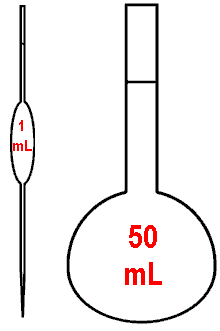
Now the
question is: what is the final concentration of compound
A in the diluted sample? The key to dilution problems is
the fact that the total amount of compound A that is
diluted - measured in grams or other units of weight -
does not change. For example in the above example, we
start out with 1 mL of sample that contains 50 mg/mL of
compound A. This means we begin with 50 mg of A
in the 1 mL of initial sample solution. We can generalize
this by proceeding as follows:
concentration
of A = (quantity of A) / (volume of solution)
quantity of A =
(concentration of A) x (volume of solution)
= (50 mg/mL) x (1 mL)
= 50 mg of A
We can also write for cases
of this type:
(initial
quantity) = (final quantity) or
C1
x V1
= C2 x V2
Here C1 is the
concentration of A in the initial solution and V1
is the volume of that solution (volume of the pipette); C2
is the concentration of A in the final solution (after
dilution) and V2 is the volume of final
solution (volume of the flask).
Now we have 50 mg of A
in the initial 1 mL of sample solution that is pipetted,
and the final volume of solution after dilution is 50 mL.
So the concentration of A in the final sample solution is:
(quantity of A)
/ (volume of solution) = (50 mg)/(50 mL)
=1mg/mL
In solving dilution problems we can
proceed in various ways. We can simply calculate a
DILUTION FACTOR (DF) as the ratio of the flask volume (V2)
to the pipette volume (V1):
DF = V2
/ V1
Then from we can write:
C2
= C1 x V1
/ V2 = C1
/ DF
That is, our final sample
concentration C2 is equal to the initial
concentration C1 divided by the dilution
factor DF. Or we can rearrange into
C2 = C1
x V1 / V2
and solve for the new
concentration C2 in terms of the initial
concentration (before dilution) C1, the
pipette volume V1, and the flask volume V2.
You should use whichever of these dilution calculations
you feel comfortable with. Most people use the dilution
factor approach.
|