By Anonymous on Friday, January 11, 2002 - 01:14 pm:
Am I correct in thinking that if you always run acidic mobile phases on silica columns, you don't need a pre-column? It's only purpose is to pre-dissolve some silica into basic phases, right?
Checking on prices for my preferred column, I see that a 10 mm guard column costs $180 and that a 150 mm analytical column costs $195. What's the point of using a guard column in this case? Doesn't it just add to the dead volume (because of extra tubing and column fittings)? If I suspect the column has been mucked up, doesn't it make more sense to change the whole thing instead of trying to save $15 by changing only a guard column?
By Uwe Neue on Friday, January 11, 2002 - 03:40 pm:
I have never seen the reason why one would want to use a precolumn. It is not needed in normal phase chromatography, and in RP, I have a C18 column. Why should I dump silica from the precolumn on my nice clean C18 column?
I have always recommended guard columns, but I am arguing from a base where the price ratio of an analytical column to a guard column is around 5 to 1 or even 10 to 1. I can't see that a single guard column costs $180. Check again! I bet that you are looking at a six-pack :-)
By bill tindall on Friday, January 11, 2002 - 07:06 pm:
I have no experience in the world of bio stuff with gooky protiens etc, so this comment is in the context of industrial chemicals analysis. Guard columns are a needless expense. I worked at a company that did thousands of analyses a year and guard columns were seldom to never used. The benefit to cost was not there. Catching a polymer with a K of 100000+ was one valid use. Unless one can determine when to change them, which should be just before stuff breaks through onto the analytical column, they likely will not pay. Invest in a good precolumn filter instead; they do pay.
By H W Mueller on Sunday, January 13, 2002 - 11:17 pm:
As evidence accumulated that plugging problems where mostly due to frits, I also changed to using mostly prefilters instead of guard columns, even with biological "goo".
By Uwe Neue on Monday, January 14, 2002 - 03:43 pm:
I should have clarified that most of the work in our lab uses samples of rather messy origin, especially plasma samples. On the other hand, we have demonstrated that even with clean samples it pays to have a guard column. Under identical use conditions with a fairly clean sample, the column lasted for 2000 injections without a guard column, but when used with guard columns, there was not the slightest change in performance after 10 000 injections. Of course, at some point in time the cost of the replacement of the guard columns exceeds the cost of a new column, but in our studies, the guard columns won...
By bill tindall on Monday, January 14, 2002 - 04:41 pm:
Que for Uwe........If one uses a guard column, how do you judge when to change it? I never used them , so this querry is from a position of ignorance. I would suppose that idealy one would change just before the junk one was trapping broke through to the main column. But other than a guess, how would you know when that was about to happen? I probably would have tried them if I ever could have come up with some rational strategy for changing them.
It will be a week before I see the answer as I am off to N. FL to canoe the springs. Supposed to be in low 70's.
By H W Mueller on Monday, January 14, 2002 - 11:59 pm:
Since I am not doing chromatography exclusively itīs not possible to look at this problem systematically in this laboratory. With the exception of size exclusion columns, Pinkerton columns (restricted access), or prep columns I do not recall significant deterioration of column performance (resolution, peak shape....) by components in the sample or mobile phase. Of course, dangerous pH were avoided. The problem was almost always plugging of frits, as I mentioned on several occasions. Therefore, we change pre-filters or guard columns (since when is there a diff between guard columns and pre-columns?) when flow resistance comes to a point where it is not acceptable (flow fluctuations). In spite of pre-protection and irrespective of the cleanliness of injected samples, there are still some flow restrictions (even permanent ones, not removable by reversing the column) happening occassionally. Recently it has been impossible to get small amounts of stat. phase or frits for repairing of some columns. It is, therfore, not possible to ascertain whether these occassional flow restrictions are still due to the frits.
By Uwe Neue on Tuesday, January 15, 2002 - 02:33 pm:
We get all the different phenomena that one would get from a "dead" column: peak distortion, high pressure, sometimes both.
In the specific studies that I mentioned, we just injected a rather clean sample. The guard columns were replaced, when the column had failed. It happened fairly regularly, meaning that the source was the same. If you do routine analysis, you would know at what point in time your column goes belly up. You replace the guard column always at some safety margin before this point.
When the reference columns in our studies failed, we tried to resurrect them by replacing the frits. No success. At the same time, if you replace the guard column fairly early after the failure, there is not yet any damage to the main column.
We did another study with plasma samples. The story was the same, only the guard columns failed much earlier than with the rather clean samples described above. Of course, here you have a clear cause-and-effect scenario...
By H W Mueller on Wednesday, January 16, 2002 - 12:38 am:
Uwe, I think this is worthwhile to pursuit. Did you make your systematic observations on a modern C18 column? Others as well? Did you wash these columns frequently? Too bad that I really donīt have real systematic observations, let alone a systematic study. Nevertheless, we almost always have the plugging problem (modern C18) long before peak deterioration, thatīs why replacing frits (or guard columns, or pre-column filters) usually helped. Also, I canīt recall that a flow restriction caused peak distortion.
Using radioactive (gamma) samples one sees that something always gets hung up, especially at the beginning of the column, apparently permanently (has been difficult to prove the permanence, because of short half-lives). One knows, though that material accumulates from the discoloration at the beginning of older columns. Even brown material there did not necessarily give rise to column deterioration. Could it be that deterioration in your observations was due to other factors than accumulation of material (I mean material that can not be washed from the column)?
Maybe the following consensus is possible?: Always use a pre-column filter, use a guard column when in doubt or when proven to be useful, use a pre-column only if you need a psychological lift.
By Anonymous on Wednesday, January 16, 2002 - 12:09 pm:
I use a guard column only when I am analyzing a new substance. Generally, If I think there is a problem with the guard column, I'll run a standard with and without it. The chromatograms should be very similar if the guard column is functioning correctly. Always use a pre-filter.
By Uwe Neue on Wednesday, January 16, 2002 - 04:57 pm:
The studies were done on a modern C18, about 5 years ago, if I remember correctly. I did not wash the columns, ever, since we were originally not only interested in the performance of the guard column, but also in the performance of the analytical column. I did not want to change retention times by purposely washing partially hydrolyzed C18 from the column. What shocked me was that in the first experiment, the retention time on the analytical column after 10 000 injections was indistiguishable from injection 100. On the second column, we did get a measurable shift, but it was in the order of 10% after 10 000 injections.
I know the brown color of old column inlets, but I have to admit that I never tried to find out if it is organic or iron. Or maybe a mix of both. I am aware of Engelhardt's studies on the complexing ability of columns, which changes with time due to metal accumulation.
Actually, I should not talk too much about guard columns. If the column lifetime would always be that good, this would not be good for me... :-)
By H W Mueller on Wednesday, January 16, 2002 - 11:25 pm:
Donīt worry about that, we all are quite good in developing new ways to kill columns.
By Vojtech Zabka on Thursday, January 17, 2002 - 01:24 am:
I'm using a RP column for 2 years. Over 2000 injections was made. I've changed guard column after about 300 injections (often after plate number decreased). I think that contaminants did not enter the column and the decrease in plate number was due extra mixing volume (20 mm guard). I do not see almost any retention time shift even thought I frequently wash the column with 100% acetonitrile. Althought, recently, I faced some problems with quantitation, I believe that they were not column related.
I use guard columns in all my applications.
By Anonymous on Thursday, January 17, 2002 - 08:24 am:
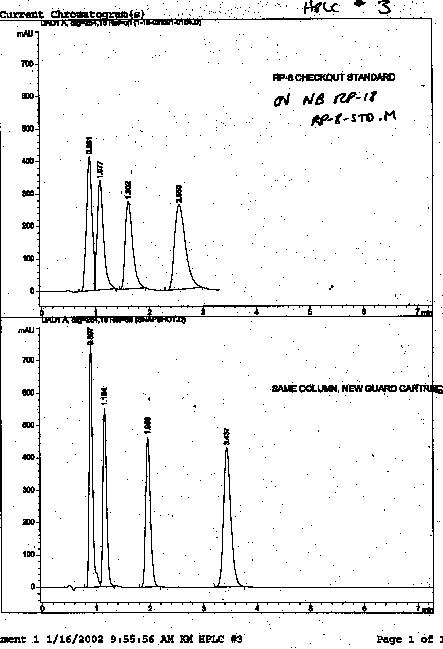
Here's real life situation from my lab, yesterday, showing restored resolution by replacing the guard cartridge. If I'm lucky enough to be able to attach the chromatograms, they show a test mix before replacing the guard cartridge, and after replacing it. The guard column 2.1mm x 30mm costs $65 and the analytical column 2.1mm x 100mm costs $250.
 1.cdf 1.cdf1.jpg (70 k) |
By Mike on Thursday, January 17, 2002 - 12:45 pm:
Lately I've been seeing gradual loss of plates when running dissolution samples (noticeable broadening over a 100 inj run). It seems like plates can be restored w/ a good flush (I do both 95% H2O and 100% ACN at elevated temp). Retention time and pressure do not change. We don't have the time to positively isolate the problem, but I've been thinking it's due to the gelatin from capsule shells (column temp = 25C, so gelatin might not be soluble in disso samps anymore), and that a precolumn would help save columns. Does this make sense? Are other common pharamceutical excipients known to "foul" columns, despite 0.45 um filtration? Does anyone always use guards to deal w/ gelatin, or have any other way to deal w/ disso samps that contain it? Or am I nuts? Oh, column is C-18, 3 um, 57:43 MeOH:Buffer pH 2.6-ish.
By H W Mueller on Thursday, January 17, 2002 - 11:54 pm:
Thanks Mike, flushing, especially backwards, has taken care of most of the resolution and plugging problems here.
Anonymous with the attachment: did you wash your columns before junking your $65 guard?
(Still, not to confuse the issue: with some columns and horrible goo I also use guard columns.)
By Anonymous on Friday, January 18, 2002 - 09:46 am:
From the chemist who posted the attachment: we routinely clean the guard/analytical column at the end of a run sequence, by programming the last line on the sequence table to be a wash program which increases the % acetonitrile to about 90%, so the system will be clean for the next sequence next day. No, in this instance I did not try to reverse-flush the guard cartridge but have done that in the past with excellent results when some polyacrylate thickener (which made it through a 0.45u membrane while in methanol solvent but apparently was less soluble in my water-ACN mobile phase) began plugging up pores in my guard cartridge frit or guard cartridge, building up pressures after about a dozen injections. Glad to see that the attachment worked, I put file into .jpg, renamed as a .cdf and it worked, good for a non-computer person. I use Agilent, don't know if I can save a chromatogram directly into .cdf, anyone know?
By Anonymous on Monday, January 21, 2002 - 09:29 am:
I use HPChem and Millenium. Both have export functions that create .cdf files (look in help under .aia). I also use the ChroMerge software that is advertised at the beginning of this forum. It works reasonably well. I usually add the chromatogram as an object in Power Point and annotate it there.
By Anonymous on Tuesday, January 22, 2002 - 07:35 am:
 1.cdf 1.cdf1.cdf (8 k) |
| Posting is currently disabled in this topic. Contact your discussion moderator for more information. |