


 By Anonymous on Tuesday, June 3, 2003 - 01:53 pm:
What do you look for when evaluating a chemical's structure for the purpose of RP HPLC? Thanks for any help.
By Tom Mizukami on Tuesday, June 3, 2003 - 04:34 pm:
There is a lot of information in the structure that may be applicable to the separation. I'm generally just looking for background information that will help point me in the right direction if problems are encountered during development.
I look for acidic and basic groups and try to mentally estimate the pKa's. I look for lone pair electrons that can form 5 or 6 member rings when complexed with metal ions. I mentally perform the Newman projections and look for bulky groups that can form structural conformers or rotamers. I also look for functional groups that are going to be susceptible to acid or base catalyzed hydrolysis or oxidation under aqueous conditions. I also look for the chromaphores and how these are going to be affected by pH, hydrolysis, or oxidation.
All of that said, I take a very empirical approach to method development. I normally start with an automated screen against columns, pH, organic, and temperature almost regardless of structure.
Here is a molecule: 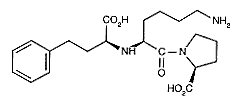 .
.
I will leave it to you to see how many problems you could anticipate.
By Alex on Wednesday, June 4, 2003 - 12:23 am:
Basically, Tom said everthing. But here is my approach:
First look for chromophores etc. Any experimental work will be waste as long as you cannot detect the substance.
Second estimate the polarity. Most organic compounds are suitable for RP-LC.
Most times one has to separate a compound for something else (matrix, impurities....) Then look at the structures and mark the differing points. Based upon the differences of the molecules on can get an idea how the separation might work (e.g. differences in polarity -> C18 will do; differences in pi-system -> try also phenyl or embedded polar columns; differences in the polar groups -> try non-endcaped material....).
By A.Nonymous on Wednesday, June 4, 2003 - 09:04 am:
There has been an article in LC GC a few months ago:
LC GC article
Good luck
By Anonymous on Tuesday, June 10, 2003 - 05:12 am:
i would like to know more examples of structural base method development so that we can perform fast method development with minimal runs.
any book or more articles are there on structural based method development please inform .