| The reservoir that holds
the mobile phase is often no more than a glass bottle.
Often, the reagent bottle that holds our HPLC solvent can
be used as a reservoir. Solvent is delivered from the
reservoir to the pump by means of Teflon tubing -- called
the "inlet line" to the pump. Some HPLC systems
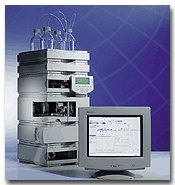
like the Agilent 1100 shown at the right have special
compartments to hold one or more mobile phase reservoirs.
The reservoirs in these systems may have additional
features that allow the mobile phase to be degassed and isolated from contact with air.
|
This Agilent 1100 HPLC system has a mobile phase compartment visible at the top of the instrument.
|
|
The
requirements for a solvent reservoir are simple:
|
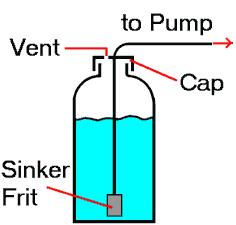
This "generic" mobile phase reservoir shows the principle components of the reservoir module.
|
|
| Examples of mobile phase
reservoirs range from standard laboratory glassware such
as beakers or flasks covered with aluminum foil through
larger vessels such as media bottles, solvent jugs, or
carboys, to purpose-made glassware that includes built-in
provision for stirring and degassing. Stirring capability is not absolutely required, but can help to keep the mobile phase homogeneous as solvent is lost to evaporation. Degassing -- removing dissolved air from the mobile phase -- is not always required, but it is generally recommended for reliable operation. We will have more to say about degassing when we cover pumping systems.
|
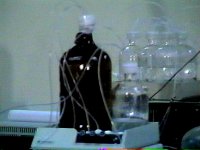
Mobile phase reservoirs range from purpose-made containers through standard solvent jugs.
|
|
| It is important that
particulate matter be kept out of the mobile phase since
particulates can damage the pump and injector as well as
plug the column. Mobile phases are often filtered before
adding them to the reservoir. In addition, a 10-micron
frit or inlet filter should be connected to the end of
the inlet line that dips into the reservoir. This inlet
frit serves more than one purpose. Besides providing
extra protection against particulates entering the pump,
the inlet filter serves to hold the inlet line at the
bottom of the reservoir. The stiffness of the inlet line
tends to allow this Teflon tubing to creep out of the
reservoir, preventing use of all the mobile phase unless
an inlet filter is used to weigh down the end of the
tubing. For this reason, inlet filters are often called
"sinkers".
|
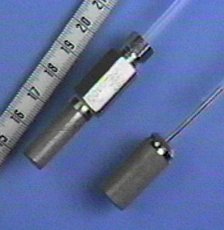
"Sinker" frits help keep the inlet line submerged and provide a final line of defense against particulate contamination.
|
|
| The sinker
frit is not a substitute for filtering the mobile phase.
The typical pore size used in a sinker frit is on the
order of 5 - 10 microns; frits of smaller pore size are
too likely to plug. In general, the mobile phase should
be filtered through a 0.3 to 0.5-micron frit after the
solvents and buffers are mixed in order to remove
particulate matter. The sinker frit protects against the
occasional larger dust particle encountered after the
mobile phase has been filtered. Despite the relatively large pore
size, sinker frits can and do get plugged over time. This
is especially likely to happen with aqueous buffers as a
result of bacterial growth. It is a good idea to
periodically check the inlet frit to be certain that
mobile phase flows freely. The "siphon test" is
a good way to accomplish this:
|
||
| It is often
necessary to remove dissolved air from the mobile phase
before the mobile phase is fed to the pump. This
procedure is called mobile-phase degassing. The reason for degassing the
mobile phase is that dissolved air tends to be released
inside the HPLC system. This makes the operation of many
HPLC pumps unreliable, leading to fluctuations in flow
rate. Bubbles can also get trapped in the detector flow
cell, causing problems with this module as well.
|
||