| RANGE: See ATTENUATION.
|
||
| RECORDER: an LC
system module that provides the final
chromatogram as a tracing on the recorder chart paper.
|
||
| REFRACTIVE INDEX (RI)
DETECTOR: a less popular detector based on change in refractive index
of the mobile phase due to the presence of sample; less
sensitive than photometric detectors for most compounds, and cannot be
used with gradient elution. However it is a more nearly a
"universal" detector, in that most compounds
will give a response at sufficiently high concentrations.
Used mainly for size-exclusion chromatography.
|
Waters 2410 RI Detector
|
|
| RELATIVE
RETENTION: see SEPARATION
FACTOR
|
||
| RESERVOIR: in LC
the bottle or other container that holds the mobile
phase that feeds
the pump.
|
||
| RESOLUTION (Rs ):
defines how well separated two adjacent bands are. Larger values of resolution
mean better separation.
|
Resolution is the ratio of separation to average baseline width.
|
|
| RESPONSE FACTOR:
here it is defined for external-standard analysis as the size of peak X
divided by the concentration of X in the calibrator. If the calibration line passes
through zero, then the Response Factor is the slope of
the calibration line. The concentrations of X in
different samples is then obtained by dividing the peak
size by the response factor.
|
The calibration plot is a graphical representation of the relationship between peak size and amount of analyte injected.
|
|
| RETENTION
FACTOR (k): see
CAPACITY FACTOR.
|
||
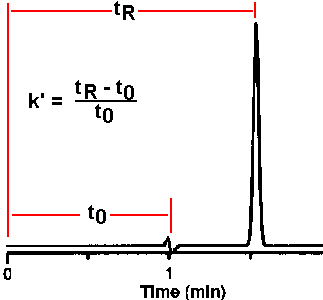
| RETENTION TIME (tR): is
the time between sample injection (time zero) and the
appearance of the band maximum; when all conditions are
held constant, the retention time for a given peak (or
compound) remains constant.
|
Retention time can vary with changes in flow or column size.
|
|
| REVERSED-PHASE
LC: the most common form of HPLC.
Water-containing (polar) mobile phases are used with
special column packings that have a hydrophobic
(non-polar) surface
layer.
|
||
| RUN: a single
chromatographic analysis or separation of one sample (one
time). In some automated systems, a RUN may refer to a
series of chromatograms including both standards and
multiple samples in a predefined sequence.
|
||