| SENSITIVITY:
generally refers to DETECTOR SENSITIVITY, the ability of
the detector to give larger bands (other factors
equal) and a better signal-to-noise ratio. This provides
more precise analysis of very small sample concentrations.
|
||
| SEPARATION FACTOR (a):
defined for two adjacent bands as the ratio of k' for the second band divided by k'
for the first band; when the separation factor equals 1.00,
the two bands are on top of each other and completely
unseparated. Changing the experimental conditions can
increase a and permit the two bands to be
separated. Also sometimes called RELATIVE RETENTION.
|
The separation factor is a measure of the selectivity of a separation.
|
|
| SERIAL NUMBER:
refers to the identification number of a column, part,
module or LC system; used to identify a particular item
so that it is not confused with a similar item.
|
||
| SILICA: a
glasslike material used to make the particles of column
packing. Its chemical formula is Si02.
|
||
| SINKER: the inlet filter that connects to
the end of the line that feeds mobile phase to the LC
pump. Also serves to weight the inlet line to keep it at
the bottom of the reservoir.
|
||
| SIZE-EXCLUSION
CHROMATOGRAPHY (SEC): another HPLC method, different
from reversed-phase chromatography. Size-exclusion chromatography is
used mainly to separate high-molecular-weight samples and
to determine their molecular weight or molecular-weight
distribution. Also called GEL FILTRATION (GFC) or GEL PERMEATION CHROMATOGRAPHY (GPC).
|
||
| SOLVENTS: the pure
components of the mobile phase (e.g., water, methanol,
acetonitrile). In reversed-phase chromatography, water is
a WEAK SOLVENT, so mobile phases with higher
concentrations of water are weaker and give longer
retention times for all sample bands. Methanol is a STRONG SOLVENT, so increasing the amount of
methanol in the mobile phase makes it stronger, and
sample bands leave the column sooner.
|
||
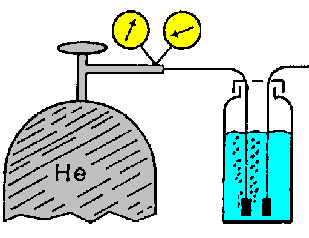
| SPARGING: refers
to bubbling a gas (usually helium) through the mobile
phase to drive out dissolved air. See Degassing.
|
Helium sparging is one of the most effective ways of removing dissolved gas from the mobile phase.
|
|
| STANDARD: a sample
with a known concentration of some compound X that is to
be determined by an LC procedure. The concentration of X
in a sample is determined by comparing its peak size with
the peak size of the standard. Also called the CALIBRATOR.
|
||
| STATIONARY
PHASE: the particulate material packed
inside the column; also, the bonded
phase that is part
of the column packing.
|
||
| STRONG SOLVENT or MOBILE PHASE: a
strong mobile phase is one that gives shorter retention
times for all sample bands; in reversed-phase chromatography, methanol and acetonitrile are strong solvents, and water is a
weak solvent. Mobile phases with more methanol or
acetonitrile will be stronger than mobile phases with
more water. So 80% methanol/water is a stronger mobile
phase than 20% methanol/water.
|
||